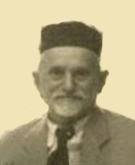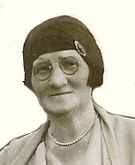
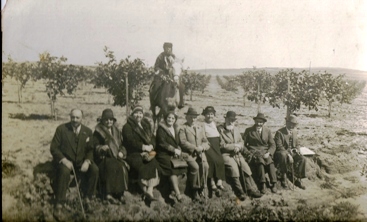
Eliezer and Bella Bernstein (center) in thier young grove
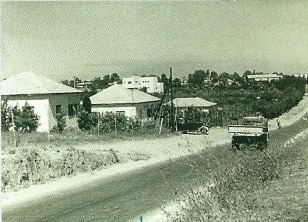
"The Bernstein neighborhood" in its early days, the 1930s (of the 20th century)
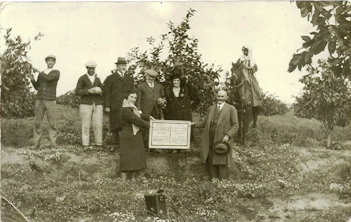
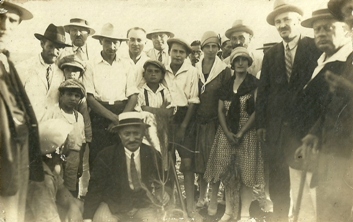
"The first planting celebration on Eliezer Bernstein's land in Rishon Le Zion (Eretz Israel). August 1929
Eliezer Bernstein (on the right) in his orange grove with the sign "The orchard planted in cooperation with the plantation company"
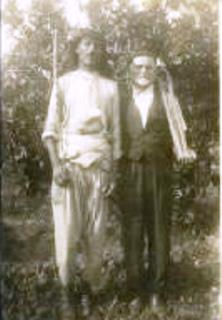
Eliezer Bernstein (on the right) in the orchard with the Arab worker
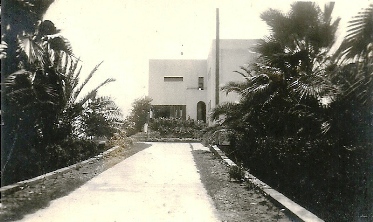
The Bernstein House
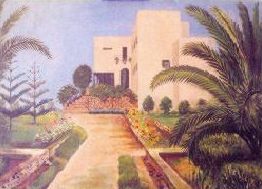
The painted Bernstein House (delivered by Sir Arthur Gilbert)
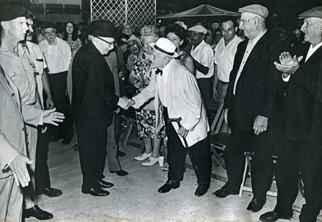
Eliezer Bernstein (on the right) shaking hands with the President of the State of Israel Shazar at an event honoring the veterans of the winery, 1972
Eliezer Bernstein was born in Wlodava in the district of Shedlitz in Poland. In the year 1896 he emigrated to England, settled in London and began manufacturing millinery. In the course of time his business developed into a large enterprise engaged in the manufacture of furs and millinery. He was a staunch Zionist and wanted to settle in Palestine. In 1925, on the occasion of the opening of The Hebrew University on Mt. Scopus, he visited the country for the first time and purchased land on the eastern boundaries of Rishon le Zion alongside the British Army camp "Sarafand", (today Tzrifin). His intention was to bring over all the members of his family from Poland and settle them on his land and indeed, he did later succeed in bringing over some 70 relatives and in so doing saved them from the fate of Polish Jewry exterminated in the holocaust during WWII. He built homes for them and provided them with work in the large orange groves that he had planted on many acres of his land.
In the early 1930s' Eliezer Bernstein built a large home on the outskirts of Rishon Le Zion. The house was planed by a Tel Aviv architect Isaac Rapoport in an international architectural style. The furniture were made by Abraham Krenitzy who later became the Mayor of the city of Ramat Gan. In the year 1934 he made "Aliya". During WWII warm and friendly relations were formed between the Bernsteins and representatives of the British government who found in the home something of the British way of life.
The British High Commissioner, Sir (1'st viscount) Herbert Samuel, high ranking British officers, members of the mandatory government, and members of the Jewish leadership were regular visitors.
The Friday night (Erev Shabbat) dinners in the house were "renowned social events". The Bernstein family who, in addition to their Zionism also supported the British Crown, attempted to make life easier for allied soldiers far from home. They set up a coffee house and dance club for British officers as well as for soldiers and nurses serving in the British Military hospital at Sarafand.
The performances of the newly created Philharmonic Ortchestra were the apex of the cultural activity in the Bernstein Villa. The orchestra would play alongside the pool on full moon nights and the music was delightful . During the period of the Arab uprising in1936, the house was used as a military outpost as well as a shelter in which many of the villagers would take refuge . The "Hagana" set up a lookout on the roof of the house which overlooked the surrounding Arab villages. Later, between 1945 ad 1948 during the struggle of the underground movements against the British, the Bernstein orange grove was used as a hideout by members of the "Etzel", "Lehi" and "Hagana" on their way to carrying out their missions. In 1948 prior to the War of Independence, when it became clear that the British were about to hand over The British Army camp at Sarafand to the Arabs, the house which had been abandoned, was taken over by the Hagana as a fortified forward outpost and strategic center for all the military activity until the camp was captured by the Givati Brigade. Throughout the years Eliezer Bernstein was involved in collecting funds for and contributing to charity.
He founded the Bnei Brith charitable fund, hosted charity balls in his home among them a ball to provide for the foundation of the Red Star of David First Aid clinic in Rishon Le Zion and himself contributed the money to purchase the first ambulance. With money he collected from friends he established a home for orphans named after his grandson who was killed as a pilot, who served in the British Royal Air Force in Europe in the 2nd World War. After the War of Independence ended he went around in his car to collect clothes for poor people and also collected contributions from people in Tel Aviv to support public needs. Riding horseback alongside his friend Meir Dizengoff, mayor of Tel Aviv, Eliezer Bernstein was a regular participant in the carnivals (adloyada) which were organized in Tel Aviv each Purim by Baruh Agadati.
Eliezer Bernstein spent his latter years with his wife and daughter Cissie in Tel Aviv. After the War of Independence the family returned briefly to their home in Rishon Le Zion but, on account of their advanced age, the difficult economic situation in the country and the expensive upkeep of the house, the villa was sold in the early 50's (of the 20th century).
To the end Eliezer Bernstein continued to work untiringly to collect money for educational institutions, orphanages,"yeshivoth" and the needy.
When he died he was brought for burial in the old cemetery in Rishon Le Zion alongside his late wife.
מספרים ש...
"In the period before the sale of the house, I was Eliezer Bernstein's driver, and I used to drive him in the very impressive Buick that was very impressive at that time," says Benjamin Abramowitz. He was also a nice, cheerful person ... He was definitely a nice and popular person ... and in Rishon Letzion he used to take buses. "